
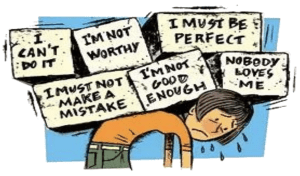
How many times in the last month have you felt any of the following:
- Not good enough
- Helpless
- Guilty
- Awkward
- Unloveable
- Incompetent
- Pessimistic
- Shameful
- Undeserving of what you have
- Like a fraud
Feeling this way doesn’t feel good, does it? It can be tough to break out of a spiral of negative and self-blaming thoughts. Many of these thoughts can be traced back to low self-esteem. If you’re experiencing thoughts like these regularly, then you might be dealing with low self-esteem.
What is low self-esteem?
Low self-esteem can be characterized by a lack of confidence and feeling bad about oneself. You might have heard and seen similar words like “self-image,” “self-perception,” and “self-concept.” All these terms refer to the way we view and think about ourselves. Low self-esteem is having a generally negative overall opinion of oneself, judging or evaluating oneself negatively, and placing a general negative value on oneself as a person.
People with low self-esteem are “hypervigilant and “hyperalert” to situations in which they may be rejected or feel inadequate because they fear making a mistake or being negatively judged. Often, people with low self-esteem are easily wounded by others because of their fragile sense of self.
How does low self-esteem develop?
Our earlier experiences affect the way we see ourselves and who we are. As a child, if you were mistreated, punished frequently in an extreme or unpredictable manner, neglected, abandoned, or abused, these experiences can leave some emotional and psychological scars. It is not surprising, then, that a person who has had these sorts of experiences in their earlier life can come to believe very negative things about themselves.
Beliefs about ourselves are learned as a result of the experiences we have had in our lives, especially our early life experiences. Often, the beliefs we have about ourselves are conclusions we arrive at based on what has happened in our lives. There are a number of factors that can influence your self-esteem.
The impact of low self-esteem
When you live with low self-esteem for a long time, it bleeds into every part of your life. Feeling low about yourself becomes your baseline. At work, low self-esteem can prevent you from forming relationships with your co-workers or from being considered for a promotion. At school, students with lower self-esteem may have difficulty with may be afraid to speak up in class, which can affect grades and opportunities in the future. It becomes a vicious cycle- you feel bad about yourself, so you keep to yourself, which then can have negative effects on you socially and emotionally, which then makes you feel even worse about yourself.
Relationships are another area where low self-esteem tends to show up. A person with low self-esteem in a relationship may feel more anxious about relationships in general. They may have a hard time believing that anyone could like them. Folks with low self-esteem see rejection or disapproval even where there isn’t any. This makes intimate relationships especially challenging because of the perceived threat that their partner is going to leave or be unfaithful. also may have anxiety that their partner will leave them or that they will be unfaithful. The effects of low self-esteem on relationships can be an emotional roller coaster ride.
Characteristics of a person with low self-esteem
Not everyone with low self-esteem acts the same way. Here are some things that a person with low self-esteem might experience:
- Insecurity
- Social Isolation
- Negative attitude
- Discomfort in social situations
- Self-neglect
- Eating disorders
- Anxiety
- Extreme focus on what others think
Some of these things are just a natural part of life. We all feel anxious and insecure sometimes. However, if you experience these feelings and behaviors frequently enough where they impact your daily life, it may be time to seek help.
Low self-esteem is often linked to depression and anxiety. The impact of negative thinking, berating self-talk, and self-loathing feelings increases risk in developing depression and anxiety. However, there is hope. Here are a few ways to increase your self-esteem with practice.
5 simple ways to overcome low self-esteem
Remember that feelings aren’t facts
Even if you feel negatively about yourself, that doesn’t make your feelings true. This can be a tricky concept to remember, especially when you are distressed. The first step to this is to name your feelings. When you feel something, notice it. Name your emotion. Does your emotion make sense with what’s happening? Remember, just because you feel it doesn’t mean it’s true.
Practice analyzing your emotions on a regular basis. Ask yourself where the emotion comes from. Does the emotion make sense with the facts of what’s happening? If not, how can you look at things differently?
Practice ignoring your inner critic
In our last post, we talked about how to get control over your inner critic, which is the critical voice inside our head that demeans us, judges us, and always finds us coming up short. It may be hard to turn off that little voice in your head entirely, but you can get better at ignoring what it says. It can be easy to spiral into negative thoughts once you have one, so do your best to shut it down as soon as you notice it.
Figure out your values
What values are important to you? When you are clear on what your values are, it becomes easier to align your thoughts and actions with them. Do some reflecting and journaling to determine what is most important to you. Here’s a list of values to help get you started. Your values can change over time, so try to check in regularly to see what has changed and what hasn’t. Once you’ve decided what your values are, you can use them as a guide to your behavior.
Surround yourself with people who bring you joy
Do the people in your life tend to be optimists or are they more pessimistic? Do you feel confident and joyful after spending time with the people in your life, or do you feel drained and not good enough? If you feel rotten after spending time with someone, you may want to consider spending less time with them. You don’t have to cut off contact with people entirely, because that can be very hard, and it’s not always necessary.
You can actively try to spend more time with people who make you feel motivated, safe, and inspired when you see them. You can mute or unfollow people on social media who don’t make you feel good about yourself. Do what you can to spend more time with people who make you feel good instead of spending your time with people who drain you.
Write down what you are grateful for
Looking back on your day and noticing the things that you are grateful for is a powerful exercise. It might not feel like much at first, but with practice, it will help you to naturally notice the good things in your life. If you can focus on the good over the bad, you can counteract the pessimism that often goes with low self-esteem. Even when you’re struggling to break out of negative thought patterns, practicing gratitude can help retrain your brain to look for the positive instead of the negative.
For all of us, life has highs and lows. However, if you are constantly trapped in a cycle of feeling low about yourself, you don’t have to figure it out all on your own. Therapy can be a great step in developing the self-esteem you want and deserve to have. You deserve to feel good about life and good about yourself, and it is possible to feel that way. Some of us just need a little extra help to get there!
Building Safety Before Trauma Processing: A Somatic and DBT-Informed Approach to EMDR
May 25, 2026There’s a moment that happens often in trauma therapy, and many clients don’t even realize what’s happening in their body when it occurs. A session begins to feel emotionally important. A painful memory starts surfacing. The client begins touching something vulnerable, something they may have avoided for years. Sometimes there are tears. Sometimes their breathing changes. Sometimes their body suddenly
Read More
Calming Anxiety Through the Body
March 9, 2026Anxiety not only affects how we think. It also affects how the nervous system functions and how the body feels day to day. Therapeutic massage can help support nervous system regulation by working directly with the body. As the body begins to release tension, the nervous system often follows.
Read More
How Therapeutic Massage Supports Nervous System Regulation
February 16, 2026Understanding how the nervous system responds to prolonged uncertainty helps explain why many people feel physically overwhelmed even when they can’t point to a single cause. The body absorbs what the mind tries to manage. Over time, this accumulation can create patterns of tightness, discomfort, and dysregulation that don’t resolve simply by “relaxing” or pushing through.
Read More
Chronic Pain and the Nervous System
January 9, 2026Living with chronic pain can be confusing—especially when tests come back normal and the discomfort seems to move, flare with stress, or settle into areas like the neck, jaw, hips, or lower back. In many cases, the issue isn’t only muscular or structural. It can be rooted in a nervous system that has learned to stay on high alert after prolonged stress. This post explores how chronic stress can translate into real physical pain, why symptoms may feel unpredictable, and how therapeutic massage and counseling at Soar Therapy and Integrated Wellness can work together to support regulation, reduce flare-ups, and help the body begin to recover.
Read More
Stopping Emotional Spiraling with DBT Skills
December 17, 2025For many adults, emotional spiraling can feel sudden and overwhelming. It might show up as racing thoughts late at night, emotions escalating quickly during conflict, or a minor stressor suddenly feeling unbearable. You may replay conversations, imagine worst-case scenarios, or feel flooded with emotion that seems to take over your body. Even when you know you are spiraling, stopping it can feel impossible.
Read More
DBT for Childhood Trauma in Northern Virginia | Skills for Trauma Survivors
December 1, 2025When Childhood Trauma Still Hurts: How DBT Helps You Cope Today If you grew up in a home where there was chaos, criticism, emotional distance, or things that were never talked about, you might already know that childhood trauma is part of your story. You may have read about trauma, watched videos, or tried to make sense of it on
Read More
How DBT Can Help You Manage Anxiety in Northern Virginia
October 27, 2025If you live in Northern Virginia —maybe near Springfield, Fairfax, or Woodbridge —you don’t need a reminder that life here moves fast. Between long commutes, competitive workplaces, high-performing schools, and the constant pressure to stay ahead, it can feel like you’re always sprinting just to keep up. It’s not unusual to have a demanding job, while working towards an advanced
Read More
DBT Skills for Everyday Life: Interpersonal Effectiveness
October 14, 2025DBT skills for interpersonal effectiveness teach you how to ask for what you need, say no with confidence, and maintain self-respect while building stronger relationships. Discover how DEAR MAN, GIVE, and FAST can transform your communication and connections.
Read More
Why DBT Works for Emotional Dysregulation
October 7, 2025Emotional dysregulation can make life feel unpredictable and exhausting. Dialectical Behavior Therapy (DBT) offers a structured, skill-based approach to help individuals regain balance, manage emotions, and build healthier relationships. Through mindfulness, distress tolerance, emotion regulation, and interpersonal effectiveness, DBT provides real, lasting change for those struggling with intense emotions.
Read More
The Transformative Power of DBT Skills Group
September 30, 2025Are you or someone you care about struggling with overwhelming emotions, impulsive reactions, or challenges in relationships? At Soar Therapy and Integrated Wellness, our DBT Skills Groups are offered twice a year in Springfield, VA, providing a unique opportunity for women and teens in Northern Virginia and the DC Metro area to achieve meaningful and lasting change. What Makes Our
Read More
Interested in our services?
Talk to one of our Client Care Specialists! We provide virtual services for any resident of Virginia. In-person services are available in Springfield, VA
Book A FREE 15-Minute Consult